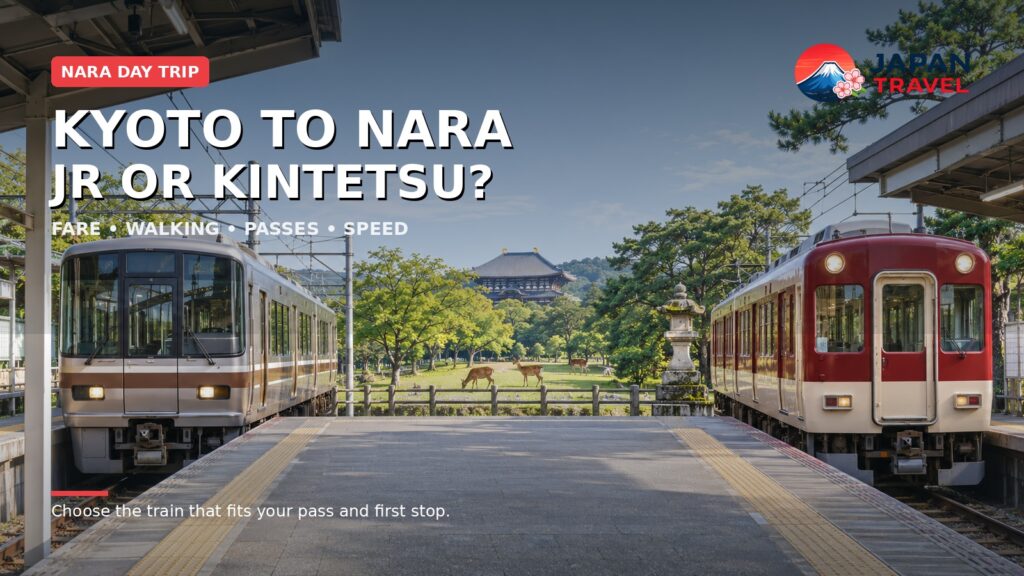
For most first-time Nara day trips, take Kintetsu from Kyoto because Kintetsu-Nara Station is much closer to Nara Park. Choose JR when you already have a valid JR pass, want to combine the journey with Fushimi Inari, or prefer the simple direct Miyakoji Rapid to JR Nara Station.
The ordinary fares are close—¥720 on JR and ¥760 on Kintetsu—so saving ¥40 each way should not control the choice. The more important difference appears after the train: Nara Park is roughly five minutes on foot from Kintetsu-Nara Station, versus about 20 minutes from JR Nara Station.
Fares and official access information checked November 26, 2026. Train times and special services vary by date, so confirm your exact departure before travel.
Affiliate disclosure: This guide includes a verified Saily link where mobile data genuinely supports live train directions. Japan Travel may earn a commission from an eligible purchase at no extra cost to you.
JR vs Kintetsu at a glance
| Decision | JR Nara Line | Kintetsu Railway |
|---|---|---|
| Ordinary one-way fare | ¥720 | ¥760 |
| Typical direct journey | About 41–47 minutes by Miyakoji Rapid | About 45–50 minutes by ordinary Express |
| Nara arrival | JR Nara Station | Kintetsu-Nara Station |
| Walk to Nara Park | Roughly 20 minutes | Roughly 5 minutes |
| Seat reservation | Not required on the ordinary rapid | Not required on ordinary Express; required on Limited Express |
| Best pass fit | Japan Rail Pass and eligible JR West regional passes | Kintetsu Rail Pass products |
| Best default traveler | JR pass holder or Fushimi Inari combination | First-time Nara Park and Todaiji visitor |
The short decision
- Take Kintetsu if Nara Park, Kofukuji, Todaiji, the deer and Kasuga Taisha are your main plan.
- Take JR if your rail pass covers the trip and you do not mind a longer walk or short bus ride at the Nara end.
- Take JR if you want to stop at Fushimi Inari on the same travel corridor.
- Consider Kintetsu Limited Express if a reserved seat matters more than the lowest fare, but verify the exact surcharge and service.
- Do not buy a new pass automatically for one Kyoto–Nara return trip; ordinary tickets or IC-card fares are often simpler.
Choose Kintetsu for the easiest first Nara visit
Kintetsu’s decisive advantage is not the train speed. It is where the train leaves you. The official Nara travel guidance describes Nara Park as a short walk east of Kintetsu-Nara Station, while the same park is roughly 20 minutes on foot from JR Nara Station. Kintetsu lists the walk at about five minutes.
That head start matters because the classic walking route runs east from the station toward Kofukuji, Nara Park, Todaiji and Kasuga Taisha. You begin sightseeing almost immediately instead of spending the first part of the day crossing central Nara or boarding a bus. For a half-day visit, travelers with children, or anyone limiting walking, Kintetsu is usually the better default.
From Kyoto Station, an ordinary Kintetsu Express currently costs ¥760. A representative official route search shows a journey of about 46 minutes with no separate Limited Express ticket. Some services may require a same-platform continuation or operational stop around Yamato-Saidaiji, so read the departure board rather than assuming every train pattern is identical.

Do you need the Kintetsu Limited Express?
No. The ordinary Express is the practical choice for most day-trippers: no reservation, no Limited Express surcharge and only a modest time difference. Pay extra when you specifically value a reserved seat, have luggage, or want the train experience itself.
Kintetsu’s sightseeing Limited Express Aoniyoshi is a separate premium experience. As of the official March 14, 2026 fare table, Kyoto to Kintetsu-Nara totals ¥1,490 for an adult when the ¥760 base fare, ¥520 Limited Express charge and ¥210 special-car charge apply. The official route example takes about 33–34 minutes. Seats can sell out, and the train does not justify itself purely through time savings.
Use Kintetsu’s official route and fare search for the actual travel date. If you see “Limited Express,” confirm that you have both the base fare and required premium ticket before boarding.
Choose JR for pass coverage and a simple rapid train
JR’s Miyakoji Rapid connects Kyoto Station with JR Nara Station in about 41–47 minutes, depending on the timetable. The ordinary fare is ¥720, and no seat reservation or express surcharge is required. The service is straightforward for travelers already using the JR network.
The important tradeoff is the Nara arrival. JR Nara Station is useful for central Nara, Sanjo-dori, hotels around the station and onward JR connections, but it is farther from the main park-and-temple cluster. You can walk about 20 minutes toward Nara Park, take a local bus, or treat the Sanjo-dori shopping street as part of the route.
JR becomes the obvious value choice when the ride is already covered by a Japan Rail Pass or an eligible JR West regional pass. Before treating pass coverage as “free,” check whether you would buy that pass for the rest of the itinerary. Our Japan Rail Pass versus individual tickets guide explains why a short Tokyo–Kyoto–Osaka trip often does not justify a national pass.
JR is better for a Fushimi Inari combination
The JR Nara Line also serves Inari Station directly beside Fushimi Inari Taisha. That makes JR useful for a carefully paced combination: visit Fushimi Inari early, then continue south toward Nara. However, the Miyakoji Rapid generally does not stop at Inari. Use a local train for the Inari segment and follow the live departure information for the onward journey rather than boarding the first rapid you see.
This combination saves a separate cross-city trip, but it creates a long sightseeing day. Start early and limit Fushimi Inari to a realistic section if Todaiji and Kasuga Taisha remain priorities. See our Kyoto transport guide for the wider rail-first strategy.
Which route is actually cheaper?
For ordinary adult fares, the simple return-trip math is:
- JR: ¥720 × 2 = ¥1,440 return
- Kintetsu ordinary Express: ¥760 × 2 = ¥1,520 return
JR saves only ¥80 on the round trip. That is not enough to outweigh an extra 15 minutes of walking each way for most Nara Park visitors. Conversely, do not pay for Kintetsu Limited Express merely because it sounds faster: the ordinary Express is already competitive once its closer station is considered.
The Kintetsu Rail Pass 1 Day costs ¥1,900 under the current official price. A plain Kyoto–Nara return on ordinary trains costs less, so the pass needs additional covered travel or useful Nara bus rides before it becomes a money-saving choice. Run the real itinerary rather than buying it by default.
Can you use Suica, PASMO or ICOCA?
Yes. Compatible IC cards such as ICOCA, Suica and PASMO can be used on both JR and Kintetsu for the ordinary base fare. Tap in at Kyoto and tap out at the correct Nara station. The IC card does not make a JR pass valid on Kintetsu, and it does not replace a required Kintetsu Limited Express or special-car ticket.
Read our Suica, PASMO and ICOCA guide if you are deciding between a stored-value card and rail passes.
Which station is better for your Nara itinerary?
| Your first or last stop | Better station | Reason |
|---|---|---|
| Nara Park and deer | Kintetsu-Nara | Shortest walk |
| Kofukuji | Kintetsu-Nara | Very close to the eastern sightseeing route |
| Todaiji | Kintetsu-Nara | Better walking start through Nara Park |
| Kasuga Taisha | Kintetsu-Nara | Closer to the park corridor |
| Sanjo-dori and central shopping | Either | The street connects the two station areas |
| Hotel around JR Nara | JR Nara | Avoids transferring or backtracking |
| Onward JR trip | JR Nara | Remain inside the JR network |
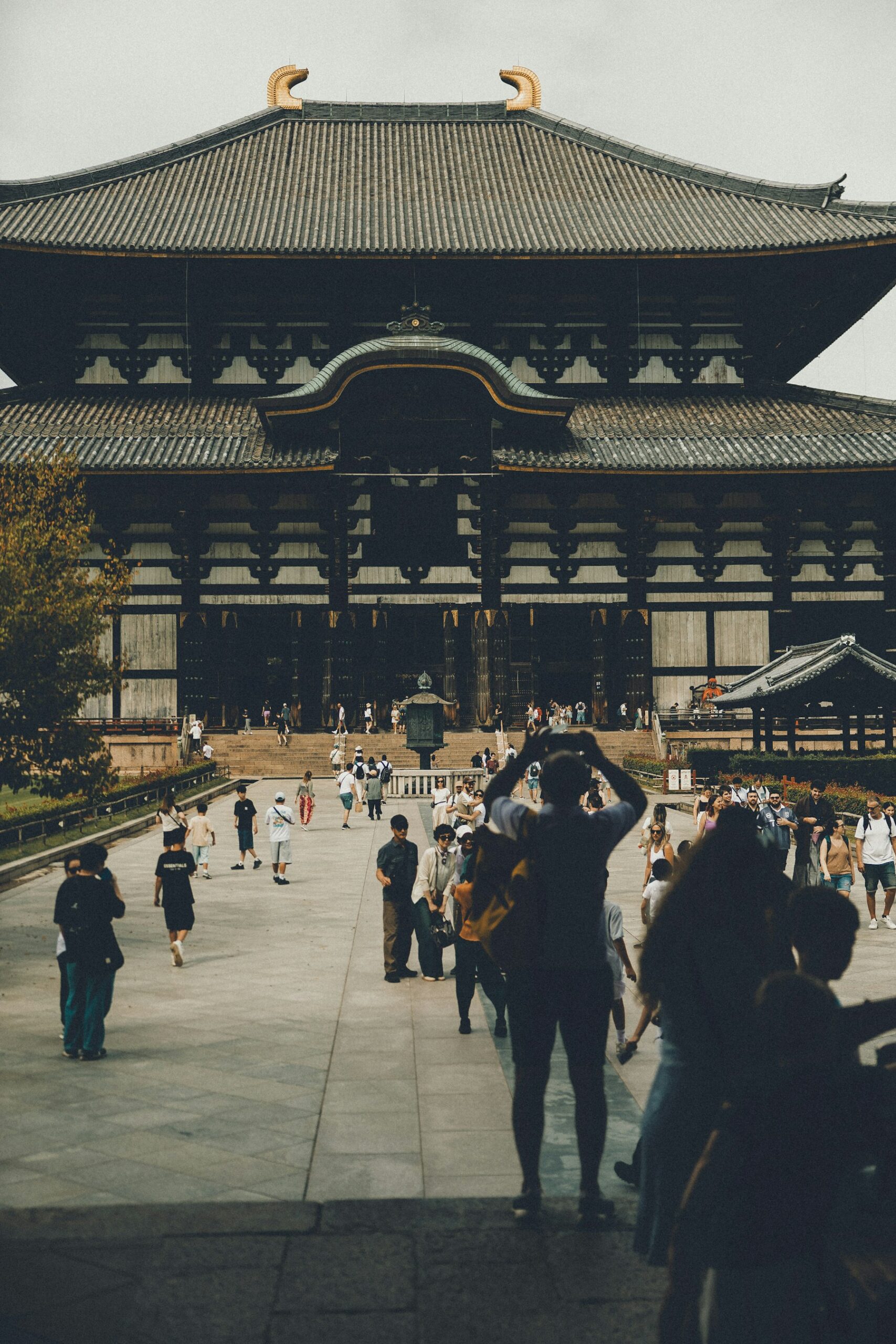
The best one-way-in, one-way-out strategy
You do not have to use the same railway in both directions. A useful open-jaw plan is to take Kintetsu from Kyoto to Kintetsu-Nara, begin near Nara Park, walk through Todaiji and central Nara, then finish along Sanjo-dori toward JR Nara Station for the return.
This only works if the walking route and evening plans naturally finish near JR Nara. Do not force it simply to sample two trains. If your day ends near Kintetsu-Nara, returning by Kintetsu is easier. Our practical Nara day-trip route helps place the attractions in a sensible order.
Families, luggage and accessibility
Kintetsu’s shorter walk to the park usually helps families, stroller users and travelers who tire easily. JR Nara Station is still accessible and well connected by buses, but the “cheaper” route can become less convenient once you add walking or a local bus.
Ordinary commuter trains do not provide the generous luggage handling of an airport train or Shinkansen. Avoid a Nara day trip with large suitcases. Leave them at the hotel, use station storage, or apply the strategies in our Japan luggage forwarding and storage guide.
Live platform information is especially helpful when an ordinary Kintetsu service pattern or JR stopping pattern is unfamiliar. If you need mobile data for maps and service alerts, check Japan eSIM options through the verified Saily tracking link. The code JAPANTRAVELCC is applied through that link; confirm the displayed offer and eligibility before purchasing.
Common mistakes
- Searching only “Nara Station” and arriving at the wrong railway.
- Boarding a Kintetsu Limited Express with only the base fare.
- Assuming every JR Nara Line rapid stops at Inari.
- Buying a rail pass before comparing it with ¥1,440 or ¥1,520 return fares.
- Planning Nara Park, Todaiji, Kasuga Taisha and distant Horyuji as one compressed walking route.
- Carrying large luggage through a day trip that already involves extensive walking.
Final verdict
Choose Kintetsu for the best default Nara day trip from Kyoto. The ordinary fare is only ¥40 more each way, and Kintetsu-Nara Station places you close to the sights most first-time visitors came to see.
Choose JR when pass coverage, Fushimi Inari, a JR Nara hotel, or onward JR travel changes the equation. The Miyakoji Rapid is simple and competitively priced; just account for the longer approach to Nara Park.
Continue planning with the Nara travel guide, the Kyoto travel guide, and our decision guide to staying in Kyoto or Osaka. If Kyoto is your base, compare Kyoto Station and Gion before choosing the train that will be easiest from your hotel.